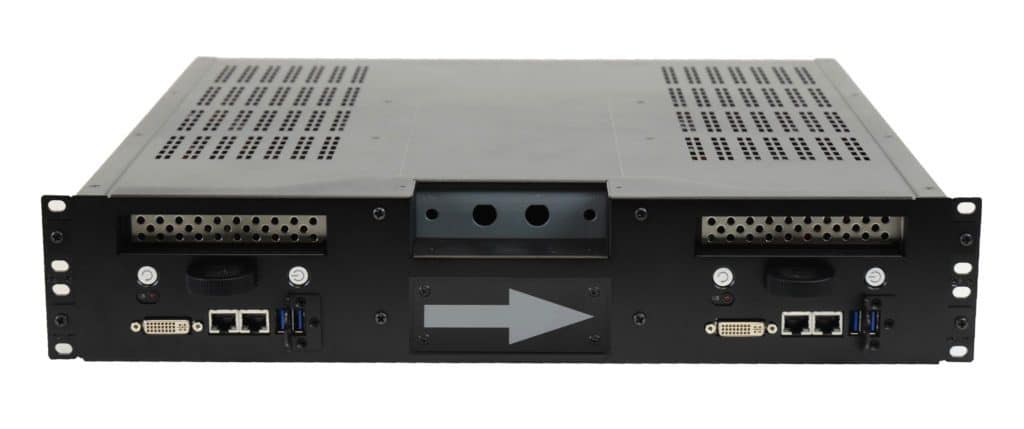
- Dual, fully independent motherboards
- Single Intel Xeon E5-1660-V4 or Dual E5-2687W-V3 / side
- 8 Cores, 3.1GHz base freq / 10 Cores 3.0GHz / side
- Up to 512GB RAM / side.
- Fiber connection to BAE Data Diode
- 2U Chassis, 18" deep
The Portexa DDDS is a 2U rack-mountable dual server with space for a BAE data diode. It has been recently updated to perform effortlessly with Gigabit connections. Two completely independent computer systems flank the data diode and ensure efficient, high speed data throughput between networks of dissimilar security clearance. Such is the independence of the computing components that the system even needs three power cords!
The Portexa DDDS is designed to perform in tactical and deployed applications - especially where space is at a premium.
Data diodes are most commonly found in high security environments such as defense, where they serve as connections between two or more networks of differing security classifications. This technology can now be found both in the military and at the industrial control world for such facilities as nuclear power plants, and electric power generation.
Network speeds are inevitably getting faster, and the latency and throughput of the servers becomes a bottleneck to performance. Portexa recently revised the DDDS to include two dual-Xeon processors per side. Up to 20 cores a side at >3GHz base frequency.
BAE data diodes are listed on the Unified Cross Domain Services Management Office (UCDSMO) baseline, and backed by a Common Criteria EAL7+ security certification. When combined with a Portexa DDDS, the Data Diode Solution offers unparalleled assurance, while delivering superior unidirectional throughput.
Connections to the networks are via Gigabit Ethernet connections, while the data that goes to the data diode travels through fiber. All the connectivity is visible from the front panel, and a nice friendly arrow indicates the direction that the information may flow.
Access to the front panel USB connections is restricted by a hasp for a padlock. Of course if a determined hacker has physical access to your hardware, it's game over, but at least it prevents opportunistic attack vectors using thumb drives.